




Regional Analysis
The Metal Packaging Landscape in Kenya
Analyzing the industrial drivers and infrastructure needs of the East African market.
Kenya serves as a pivotal industrial hub for East Africa, with a strong emphasis on agricultural exports and chemical processing. The demand for durable metal containers is driven by the need for secure transport of oils, paints, and industrial chemicals. However, much of the current infrastructure relies on aging machinery that struggles to maintain the precision required for modern safety standards. As the Kenyan economy diversifies, there is a critical need for localized production of high-quality metal barrels to reduce reliance on expensive imports and ensure supply chain resilience.
Current market trends indicate a shift toward automation and specialized fabrication. Manufacturers are increasingly seeking equipment that can handle various materials—from galvanized sheets to stainless steel—to cater to diverse industries such as solar water heating and automotive exhaust systems. The integration of laser welding pipe technology is becoming a priority for those aiming for high-precision joins and aesthetic superiority. This evolution is fueled by a growing domestic middle class and an expanding industrial base in urban centers like Nairobi and Mombasa.
The outlook for the Kenyan metal container industry is positive, provided that manufacturers can overcome constraints related to technical skill gaps and energy efficiency. The opportunity lies in adopting "smart" production lines that minimize waste and maximize throughput. As environmental regulations tighten, the transition toward recyclable metal packaging over plastics will further stimulate demand for advanced barrel making machines. Companies that invest in flexible, high-precision welding technology will be best positioned to capture the growing regional market across the East African Community.
Technology Path
Evolution of Container Fabrication
From manual assembly to fully integrated automated production systems.
Early Phase
Manual Fabrication
Production relied on basic bending and manual welding. Results were inconsistent, with high leak rates and significant material waste during the assembly of simple round barrels.
Growth Phase
Semi-Automation
Introduction of dedicated seam welding machines. This transition improved weld consistency and allowed for larger volumes of standardized 200L drums for the oil and gas sector.
Current Phase
Integrated Precision
Deployment of full production lines with pulse welding and laser options. Modern systems now handle irregular shapes and various alloy types with extreme precision and energy efficiency.
Shift Toward Modular Design
Modern fabrication is moving away from single-purpose machines toward modular units. This allows operators to reconfigure their lines to produce different barrel volumes or shapes, adapting quickly to market shifts without massive capital reinvestment.
Material Diversification
There is a significant increase in the use of stainless steel and galvanized sheets for specialized containers. This requires welding equipment capable of adjusting thermal profiles in real-time to prevent burn-through on thinner materials.
Integration of Smart Controls
The adoption of PLC-based controls allows for the precise monitoring of welding current and speed. This ensures every container meets rigorous leak-proof standards, which is essential for the transport of hazardous chemicals.
Future Outlook
Emerging Trends in Metal Container Manufacturing
How technology is redefining the standards of industrial packaging.
High-Speed Pulse Welding
Pulse technology is replacing continuous DC welding to reduce heat distortion in thin-walled containers. This results in smoother surfaces and stronger structural joints for lightweight barrels.
Eco-Friendly Production
Manufacturers are adopting energy-saving power sources and waste-reduction cutting patterns. This trend is driven by the need to lower the carbon footprint of industrial packaging.
Custom Geometry Fabrication
The market is shifting from standard round drums to irregular and square containers. This requires equipment with flexible forming dies and adaptive welding paths to maintain seal integrity.
Smart Quality Monitoring
Integration of real-time sensors to detect weld defects instantly. This reduces the need for manual pressure testing and ensures 100% reliability for high-risk chemical storage.
The transition toward automated production lines is no longer an option but a necessity for Kenyan manufacturers aiming to compete on a global scale. By implementing integrated barrel production line systems, companies can drastically reduce the human-error factor associated with manual welding. This shift is particularly vital for the production of specialized items like vacuum cleaner housings and solar water tank liners, where precision is paramount.
Furthermore, the rise of the automotive and HVAC sectors in East Africa is increasing the demand for high-quality corrugated pipes and elbows. This diversifies the application of resistance welding beyond simple barrels, extending into mufflers and condenser pipes. The synergy between flexible fabrication equipment and a growing industrial base creates a sustainable ecosystem for metal container manufacturing growth in Kenya.
Practical Applications
Implementation Scenarios in Kenya
How our machinery solves real-world production challenges across different industries.
01
Industrial Paint Barrel Facility in Nairobi
A manufacturer producing various sizes of paint barrels faced high leak rates in their 20L containers. By implementing a precision seam welding machine, they transitioned from intermittent to continuous pulse welding. This eliminated the weak points in the seam, reducing rejection rates and improving the structural stability of the barrels during transit.
02
Chemical Storage Plant in Mombasa
A company specializing in hazardous chemical drums required 200L barrels with extreme airtight seals. We provided a fully automated barrel production line capable of handling thick-walled carbon steel. The system's precise heat control ensured deep penetration welds, meeting international safety standards for chemical containment and export.
03
Solar Water Heater Manufacturer in Kenya
A local producer of solar water tanks needed precise welding for stainless steel inner liners. Using our resistance welding equipment, they achieved a high-quality seal on irregular curved surfaces. This prevented internal corrosion and leaks, significantly extending the lifespan of the solar heaters in coastal humid environments.
04
Automotive Parts Supplier for Commercial Vehicles
A supplier producing car mufflers and fuel tanks required flexible equipment for thin-walled metal pipes. The deployment of a laser welding pipe system allowed for high-speed, narrow-bead welds with minimal deformation. This improved the air-tightness of exhaust systems and reduced the weight of the finished components.
05
Agricultural Oil Container Workshop
A small-scale producer of agricultural oil buckets struggled with the slow speed of manual bending and welding. By introducing a modular barrel making machine, they were able to quickly switch between 10L and 50L capacities. This increased their production throughput by automating the forming process, allowing them to scale their regional distribution.
Deployment Evidence
Representative Operational Perspectives
Typical outcomes based on the application of our metal container solutions.
The transition to an automated production line has resolved our long-standing issue with seam consistency. We now produce 200L chemical barrels with zero leak failures during pressure testing, which has allowed us to expand our export reach within East Africa.
Switching to pulse resistance welding significantly reduced the heat-affected zone on our thin-walled stainless steel tanks. The precision is far superior to our previous equipment, and the energy savings are noticeable in our monthly utility bills.
The ability to customize the machinery based on our specific drawings for irregular barrels was a game changer. We can now produce specialized automotive fuel tanks that fit exact specifications without sacrificing weld strength.
Our Legacy
Hebei Xindrui Machinery: Two Decades of Engineering
A history of solving complex metal fabrication challenges for global enterprises.
2000
Founding of Xindrui Machinery Factory
The company began its journey focusing on the foundational needs of metal fabrication. Over the early years, it developed a core competency in non-standard equipment manufacturing, building a professional R&D team capable of handling complex technical requirements.
2000-2020
Expansion into Packaging Industry
Through two decades of continuous innovation, the company expanded its portfolio to include full production lines for metal barrels, canning equipment, and corrugated elbow machinery, solving technical challenges for numerous medium and large enterprises globally.
Present
Global Export & Advanced R&D
Today, Hebei Xindrui Machinery exports to diverse markets including the Middle East, Russia, and Vietnam. The company remains committed to "surviving with quality" and "developing products" through scientific guidance and constant innovation.
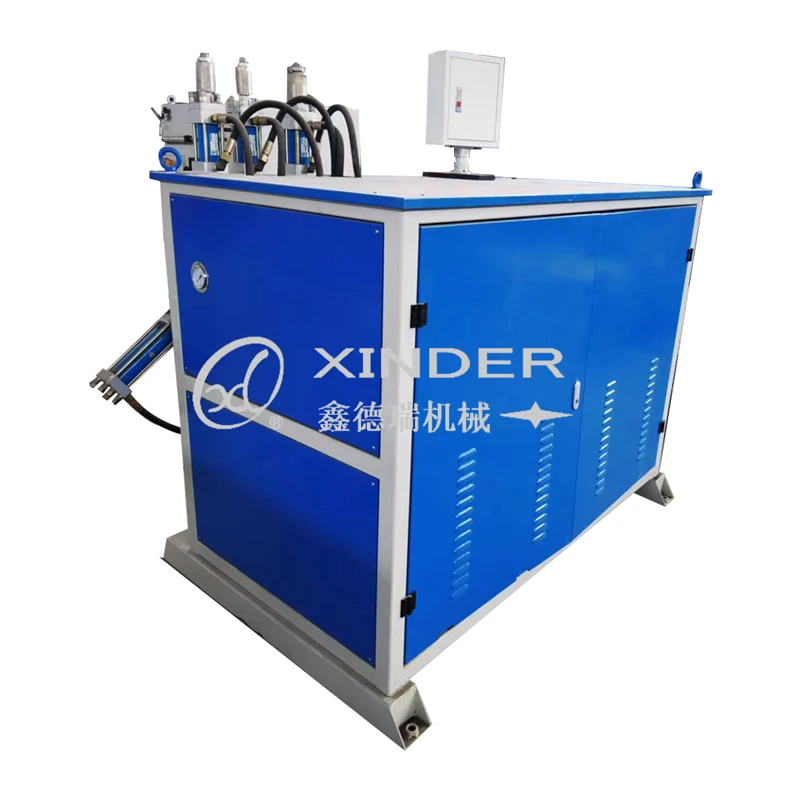
Fully Automatic Metal Bucket Lifting Headphones

Galvanized Duct Welding Machine

Vacuum Cleaner Bucket Production Line

Fully Automatic Pipe Shrinking Machine
Technical Support
Common Inquiries on Metal Container Equipment
Expert answers to the technical and commercial questions most relevant to Kenyan manufacturers.
What is the difference between pulse and continuous seam welding for metal barrels?
Continuous welding provides a constant flow of current, which is ideal for thick-walled containers. Pulse welding, however, oscillates the current, reducing the overall heat input. For thinner sheets common in paint barrels, pulse welding is preferred as it prevents material burn-through and reduces thermal distortion, resulting in a flatter and more aesthetically pleasing seam without compromising the seal's integrity.
How do I determine the right barrel production line for different capacities like 10L to 200L?
The selection depends on your target output volume and the variety of sizes you intend to produce. A fully automated line is best for high-volume, single-size production. However, for a diverse range (e.g., 10L, 50L, and 200L), modular machinery with adjustable forming dies is recommended. We can design custom solutions based on your drawings or samples to ensure the equipment handles the specific transitions between these capacities efficiently.
Can your resistance welding equipment handle both carbon steel and stainless steel?
Yes, our equipment is designed for versatility. Carbon steel, low-carbon steel, stainless steel, and galvanized sheets are all compatible. Because these materials have different electrical resistivity and melting points, our machines allow for the adjustment of welding current and timing. This ensures that the weld depth is optimized for the specific material being used, whether it is for a rugged industrial drum or a corrosion-resistant soup barrel.
What are the typical maintenance requirements for a seam welding machine in an industrial setting?
Routine maintenance primarily involves the inspection and cleaning of welding electrodes to prevent contamination and ensure consistent current flow. Additionally, the guiding rails and mechanical drives require periodic lubrication to maintain precision. Our equipment is designed with accessible components, allowing local technicians to perform these tasks with minimal training, thus reducing unplanned downtime.
Routine maintenance primarily involves the inspection and cleaning of welding electrodes to prevent contamination and ensure consistent current flow. Additionally, the guiding rails and mechanical drives require periodic lubrication to maintain precision. Our equipment is designed with accessible components, allowing local technicians to perform these tasks with minimal training, thus reducing unplanned downtime.
How does laser welding pipe technology improve automotive part manufacturing?
Laser welding offers a much more concentrated heat source compared to traditional methods, which means a smaller heat-affected zone and minimal deformation of the pipe. In automotive applications like mufflers or condenser pipes, this results in a tighter, cleaner join and a higher strength-to-weight ratio. It also allows for faster processing speeds and the ability to weld irregular joints that would be difficult to reach with conventional electrodes.
What is the next step if I have a custom design for a non-standard metal container?
Since we specialize in non-standard equipment manufacturing, the first step is to provide us with your technical drawings, physical samples, or a detailed conceptual idea. Our engineering team will then conduct a feasibility analysis and provide a targeted professional design. We can tailor the fabrication process, including the forming dies and welding parameters, to create an exclusive design solution that meets your specific industrial needs.
Ready to Scale
Optimize Your Metal Container Production in Kenya
Whether you are upgrading an existing facility or establishing a new industrial plant, our expertise in resistance welding and barrel production lines can help you achieve superior precision and higher throughput. Contact our engineering team to discuss your specific requirements and receive a tailored machinery solution for the Kenyan market.
Discuss Your Requirements