




Regional Analysis
Uganda's Metal Packaging Landscape
An analysis of the industrial transition toward localized metal container manufacturing in East Africa.
Uganda is experiencing a steady increase in demand for durable metal packaging, driven by the growth of the local agricultural processing and chemical sectors. The market primarily requires containers for lubricants, paints, and industrial chemicals. Currently, many businesses rely on imported barrels, which increases costs due to logistics and tariffs. There is a strong strategic push toward establishing local production facilities to ensure a stable supply of 10L to 200L containers, reducing dependency on external markets and fostering regional industrialization.
Technological trends in the Ugandan market are shifting from basic manual fabrication to semi-automated systems. The adoption of laser welding pipe and high-precision resistance welding is becoming a priority for companies seeking to meet international quality standards. There is a noticeable trend toward diversifying product lines, where manufacturers are no longer just producing standard drums but are expanding into specialized containers like fuel tanks for agricultural vehicles and solar water heater tanks, reflecting a broader industrial diversification.
While opportunities are vast, the market faces constraints such as intermittent power stability and a shortage of specialized technicians for high-end machinery. However, the outlook remains positive as the Ugandan government encourages local manufacturing. The transition toward integrated production lines that combine efficiency with lower operating costs will be the deciding factor for market leadership. Companies that invest in versatile equipment capable of handling various metals—from carbon steel to stainless steel—will be best positioned to capture the growing East African market.
Industry Growth
The Evolution of Metal Container Fabrication
Tracing the journey from manual artisan work to fully integrated industrial production lines.
Early Phase
Manual Fabrication
Production relied on manual cutting and basic spot welding. Quality was inconsistent, and output was limited to very small batches of standard round drums.
Growth Phase
Semi-Automation
Introduction of dedicated seam welding machines and rolling equipment. This improved the air-tightness of containers and increased production volume.
Current Phase
Integrated Systems
Adoption of complete barrel production lines with CNC controls and laser welding, allowing for complex geometries and high-speed industrial output.
Precision Material Handling
The industry has moved from rough sheet metal handling to precision feeding systems. This ensures that the weld line is perfectly aligned, reducing material waste and ensuring that every barrel meets strict pressure-test requirements for chemical storage.
Diversification of Application
Metal containers have evolved beyond simple storage. Modern lines now produce specialized items like vacuum cleaner housings, car mufflers, and solar water tanks, requiring equipment that can handle various gauges of stainless and galvanized steel.
Environmental Compliance
There is an increasing focus on reducing energy consumption during the welding process. Modern resistance welding equipment optimizes current pulses to achieve the same weld strength with lower electrical overhead.
Future Outlook
Key Trends in Metal Container Manufacturing
The shift toward smarter, more flexible, and energy-efficient production systems.
Intelligent Weld Control
The integration of real-time monitoring in resistance welding to adjust parameters automatically based on material thickness, ensuring zero-defect seams.
Multi-Material Capability
Increasing demand for machines that can seamlessly transition between carbon steel, stainless steel, and galvanized sheets without extensive re-tooling.
Modular Line Expansion
The trend toward starting with a basic welding unit and adding forming or finishing modules as business volume grows, reducing initial CAPEX.
Eco-Friendly Packaging
Developing lightweight but high-strength metal containers to reduce transportation emissions and material costs for East African distributors.
The move toward automation is not merely about speed; it is about the standardization of quality. In a market like Uganda, where precision can vary between workshops, the implementation of automated resistance welding ensures that every single unit produced is identical and meets the pressure requirements for hazardous material transport. This shift reduces the reliance on highly skilled manual welders and places the control in the hands of a programmable system.
Furthermore, the integration of laser technology into pipe and container welding is opening new possibilities. Laser systems allow for narrower heat-affected zones, which prevents the warping of thin-walled containers. For the automotive and military sectors in the region, this means higher structural integrity for fuel tanks and specialized housings, allowing local manufacturers to compete with global imports on a quality basis.
Practical Applications
Application Scenarios in the Ugandan Market
How our equipment solves specific production challenges across different local industries.
01
Industrial Lubricant Packaging in Kampala
A local lubricant blender requires 20L steel containers. Due to the viscosity of the product, any seam leak is a major environmental hazard. By implementing our continuous seam welding machine, the operator achieves a perfect hermetic seal, reducing leakage complaints to zero and increasing production speed by 40% compared to manual spot welding.
02
Agricultural Fuel Tank Production for Tractors
Manufacturers of agricultural machinery in Uganda need custom-shaped fuel tanks. Using our versatile barrel making machine, they can produce irregular geometries that fit specific vehicle chassis. The resistance welding equipment ensures that the tanks are leak-proof even under the vibration and stress of rough rural terrain.
03
Solar Water Heater Tank Fabrication
With the rise of renewable energy in East Africa, the demand for stainless steel water tanks has surged. Operators use our specialized resistance welding systems to join stainless steel sheets without contaminating the weld pool, ensuring the tanks are corrosion-resistant and capable of withstanding high internal pressures.
04
Chemical Drum Production for Mining Supplies
Supplying the mining sector requires 200L heavy-duty drums. These containers must handle corrosive agents. The use of our complete barrel production line allows the manufacturer to use thicker galvanized steel while maintaining high-speed throughput, ensuring the drums are durable enough for long-distance transport across Uganda.
05
Specialized Fire Extinguisher Box Manufacturing
For safety equipment providers, producing sealed thin-walled containers is critical. Our precision welding equipment allows for the manufacturing of fire extinguisher housings that are airtight and lightweight, utilizing pulse welding to prevent burn-through on thin metal sheets.
Deployment Evidence
Representative Deployment Perspectives
Illustrating the operational impact of transitioning to professional welding and barrel production equipment.
Transitioning from manual welding to an integrated barrel production line has solved our primary issue of weld inconsistency. We can now produce high-capacity chemical drums that pass every pressure test, allowing us to expand our client base to larger industrial distributors in the region.
The flexibility of the barrel making machine allows us to switch between round and square containers for different customers without significant downtime. The resistance welding equipment's ability to handle various metal types has made our workshop much more competitive.
Implementing automated seam welding has dramatically reduced our scrap rate. We no longer waste expensive stainless steel sheets due to weld burn-through, and the overall energy efficiency of the new system has lowered our operational costs per unit.
Our Legacy
About Hebei Xindrui Machinery
Over two decades of expertise in non-standard equipment manufacturing for the metal packaging industry.
2000
Establishment of Xindrui Machinery Factory
The company began as a specialized factory focused on solving technical challenges in metal fabrication. Over the years, it built a professional research and development team capable of creating non-standard equipment for diverse industrial needs.
Growth Period
Expansion into Metal Packaging Lines
The company evolved its capabilities to provide complete production lines for metal barrels, canning equipment, and corrugated elbow machinery, solving complex technical problems for medium and large enterprises globally.
Current
Global Market Reach
Today, Hebei Xindrui Machinery exports high-performance welding and barrel production equipment to numerous countries, including the Middle East, Russia, Vietnam, and Algeria, adhering to a philosophy of innovation and quality.
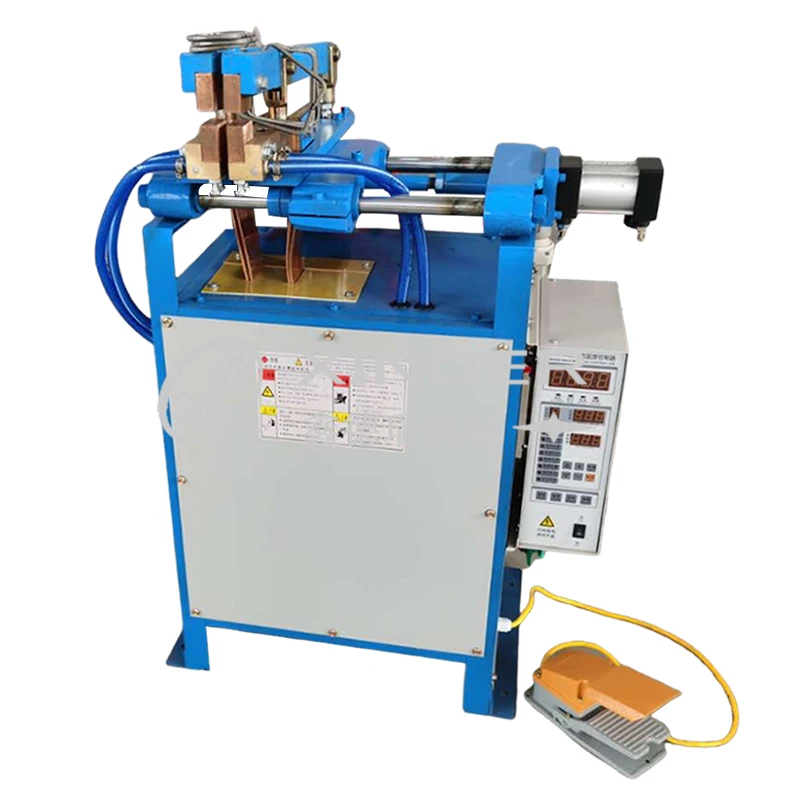
Pneumatic Handle Welding Machine

5-10 Liter Fully Automatic Seam Welding Machine

Fully Automatic Welded Pipe Machine

10-20 liter fully automatic seam welding machine
Technical Support
Frequently Asked Questions
Clear answers to common technical and operational queries regarding metal container production.
What are the primary differences between pulse and continuous seam welding for metal barrels?
Continuous welding provides a seamless, uninterrupted bond ideal for high-pressure containers and liquids, ensuring maximum leak prevention. Pulse welding, on the other hand, applies heat in bursts, which is better for thinner materials to prevent warping or burn-through. The choice depends on the material thickness and the required seal strength of the final barrel.
Can the barrel making machine handle both stainless steel and galvanized sheets?
Yes, our equipment is designed for multi-material compatibility. By adjusting the current parameters on the resistance welding equipment and using appropriate rollers, the machine can process carbon steel, low-carbon steel, stainless steel, and galvanized sheets. This versatility allows manufacturers to produce everything from industrial oil drums to food-grade stainless steel containers.
How do we ensure the equipment performs reliably given Uganda's power fluctuations?
To ensure stability, we recommend integrating the production line with a voltage stabilizer or an industrial UPS system. Our machines are built with robust electrical components that can handle standard industrial loads, but stabilizing the input current is critical for maintaining consistent weld quality and protecting the PLC controllers from power surges.
What is the typical lead time for custom-designed metal container production lines?
Lead times vary based on the complexity of the design and the specific components required. For standard lines, delivery is faster, but for custom solutions based on customer drawings or unique samples, the process includes targeted professional design and manufacturing. We provide a detailed project timeline once the final technical specifications are agreed upon.
Is it possible to upgrade a basic welding setup to a full barrel production line later?
Yes, our equipment is designed with modularity in mind. Many operators start with a high-quality seam welding machine and gradually add automated feeding, rolling, and flanging modules. This phased investment approach allows businesses to scale their production capacity as their market demand in Uganda grows without replacing their core welding assets.
How do I determine if I need a laser welding pipe system or standard resistance welding?
The decision depends on the material thickness and required precision. Resistance welding is highly efficient for standard barrel seams and thicker sheets. Laser welding is preferred for high-precision applications, very thin walls, or complex pipe structures where a minimal heat-affected zone is required to prevent deformation. We can help you choose based on your specific product samples.
Ready to Scale
Optimize Your Metal Container Production in Uganda
Whether you are establishing a new facility or upgrading an existing workshop, our team provides the technical expertise to implement leak-proof, high-efficiency production lines. We offer tailored design solutions based on your specific drawings or samples to ensure your equipment perfectly matches your local market needs in East Africa.
Discuss Your Requirements